Friday, 24 March 2017

ICT

 Hi! This term we are going to do another explanation about ICT, is to say, technology in general. We had a lot of options to choose but I went for LED technology. I don't know why. In fact, I first wanted to do protect data but I waited too much and a girl, called Paula, chose it, so I did LED. I find it very interesting; something whose importance is enormous and we use it everyday.

I'm now searching for some information about this topic and I have to say that there's a lot. Here you have some web pages:

- http://www.lighting.philips.com/main/education/lighting-university/lighting-university-browser/course/understanding-of-led-technology

- http://ecmweb.com/basics/understanding-led-technology

- http://www.edisontechcenter.org/LED.html

- https://es.slideshare.net/robcohen/led-lighting-presentation

- https://en.wikipedia.org/wiki/Light-emitting_diode#Advantages 

- http://sciencewithkids.com/science-facts/facts-about-LEDs.html

Reading these pages I finally did a brainstorm that I can follow to do my presentation:

Definition

A light-emitting diode (LED) is a special kind of diode that glows when electricity passes through it. Most LEDs are made from a semi-conducting material called gallium arsenide phosphide.
LEDs can be bought in a range of colours. They can also be bought in forms that will switch between two colours (bi-colour), three colours (tri-colour) or emit infra-red light.
In common with all diodes, the LED will only allow current to pass in one direction. The cathode is normally indicated by a flat side on the casing and the anode is normally indicated by a slightly longer leg. The current required to power an LED is usually around 20 mA.

Advantages:
  • Efficiency: LEDs emit more lumens per watt than incandescent light bulbs. The efficiency of LED lighting fixtures is not affected by shape and size, unlike fluorescent light bulbs or tubes.
  • Color: LEDs can emit light of an intended color without using any color filters as traditional lighting methods need. This is more efficient and can lower initial costs.
  • Size: LEDs can be very small (smaller than 2 mm2) and are easily attached to printed circuit boards.
  • Warmup time: LEDs light up very quickly. A typical red indicator LED achieves full brightness in under a microsecond. LEDs used in communications devices can have even faster response times.
  • Slow failure: LEDs mostly fail by dimming over time, rather than the abrupt failure of incandescent bulbs.
  • Lifetime: LEDs can have a relatively long useful life. One report estimates 35,000 to 50,000 hours of useful life, though time to complete failure may be longer. 
  • Shock resistance: LEDs, being solid-state components, are difficult to damage with external shock, unlike fluorescent and incandescent bulbs, which are fragile.


Disadvantages:
  •  Initial price: LEDs are currently slightly more expensive (price per lumen) than other lighting technologies.
  • Temperature dependence: LED performance largely depends on the ambient temperature of the operating environment. Overdriving an LED in high ambient temperatures may result in overheating the LED package, eventually leading to device failure.
  • LEDs must be supplied with the correct voltage and current at a constant flow. This requires some electronics expertise to design the electronic drivers.
History / inventors


1907 - H.J. Round discovered electroluminescence when using silicon carbide and a cats whisker. Oleg Losev independently discovered the phenomena the same year.
London, United Kingdom


1920s - Oleg V. Losev studied the phenomena of light emitting diodes in radio sets. His first work on 'LEDs' involved a report on light emission from SiC. In 1927 he published a detailed report but his work was not well known until the 1950s when his papers resurfaced.
Saint Petersburg, Russia

1961 - James R. Biard. "Bob" Biard and Gary Pittman developed the Infrared LED at Texas instruments. This was the first modern LED. It was discovered by 'accident' while TI tried to make an X-band GaAs varactor diode. The discovery was made during a test of a tunnel diode using a zinc diffused area of a GaAs (Gallium Arsenide) semi-insulating substrate.
Dallas, Texas


1961 - Gary Pittman worked together with James R. Biard. He had started working in 1958 with semiconductor GaAs for the creation of early solar cells. He discovered and developed the infrared LED with James R. Biard.
Dallas, Texas

1962 - Nick Holonyack Jr. develops the red LED, the first LED of visible light. He used GaAsP (Gallium Arsenide Phosphide) on a GaAs substrate. General Electric.
Syracuse, New York


1972 - M. George Craford creates the first yellow LED at Monsanto using GaAsP. He also develops a brighter red LED.
St. Louis, Missouri


1972 - Herbert Maruska and Jacques Pankove develop the violet LED using Mg-doped GaN films. The violet LED is the foundation for the true blue LED developed later.
RCA Labs , New Jersey


1979 - Shuji Nakamura develops the world's first bright blue LED using GaN (Gallium nitride). It wouldn't be until the 1990s that the blue LED would become low cost for commercial production.
Tokushima, Japan


1976 - Thomas P. Pearsall develops special high brightness LEDs for fiber optic use. This improves communications technology worldwide. Paris, France


How does it work?

Light is a form of energy that can be released by an atom. It is made up of many small particle-like packets that have energy and momentum but no mass. These particles, called photons, are the most basic units of light.
Photons are released as a result of moving electrons. In an atom, electrons move in orbitals around the nucleus. Electrons in different orbitals have different amounts of energy. Generally speaking, electrons with greater energy move in orbitals farther away from the nucleus.


How much do we use them?


Uses ( different examples )


gmail> luberrieleanitza@gmail.com

Friday, 17 March 2017

EXAM QUESTIONS

1- How many different kinds of amino acids do we have?
about 20
about 50
about 100
76

2- When the amino acids attract to each other, what do they produce?
living cells
proteins
tissues
another type of amino acids

3- Where does the DNA live in the living cell?
in the cytoplasm
in the RNA
in the nucleous
in the ribosome

4- Which is the main function of the DNA?
The main function is that they have to be formed in the perfect shape in order to function.
The main function is to tell amino acids how to line up and form themselves into the perfect protein shapes.
Their main function is to clean the blood
The main function is to protect the living cell and the nucleus.

6-What is the simplified model of DNA made up of?

7- What is the function of the ribosome?

Friday, 3 March 2017

GENETICS VIDEO

Hi everybody! In our subject, we speak about different topics of science in each term. This term is the turn of genetics. Personally, I don't find it very interesting, but I'm sure that I'll change my opinion. We've divided the theme in ten groups. Even though there were a wide range of options, I chose DNA. I don't know why exactly, but it sounded familiar and as we have already studied it, I decided to go for it.

The DNA is a basic and very important topic in genetics. In fact, it is a molecule that carries the genetic instructions used in the growth, development, functioning and reproduction of all known living organisms and many viruses. But I will explain it in the video better. I 've chosen a video of 5 minutes that explains perfectly each period of DNA's process. It's quite clear and the video isn't too fast. As a result, I think it was the best option.

I'm going to expose the video in front of the class and the teacher is going to keep in mind four: content, comunication, rehearsal and control. First of all, the video has to be interesting. Secondly, we've to speak fluently and finally you have to have your work prepared. That will giv you control.

https://www.youtube.com/watch?v=zwibgNGe4aY

Friday, 3 February 2017

HEALTH SYSTEM PRESENTATION

In this term, we had to do a work about some topic of medicine. Ander and I chose the topic of Health System & Healthy Lifestyle. We thought it was the option that better conected with our likes and with daily news or problems. However, after that, we noticed that the second part of the topic, healthy lifestyle, wasnt scientific enough to put in our presentation, that had to be much more connected with science. So, thats why we focused on health system.

First of all, Ander explained the ranking of the best health systems in the world. To continue, he spoke about the countries that took the best and the worst position in the ranking

My presentation focused on the Basque health system, Osakidetza

Finally, to give more importance to the healthy lifestyle, we made some quizes and questionnaires about nutrition, alcohol and healthy lifestyle. However, the time didnt help us and we only showed one quiz.

To sum up, it has been a presentation that has supposed a lot of work so I hope you like it.
http://anderoihan.weebly.com/

Thursday, 19 January 2017

EUROPEAN WOMEN SCIENTISTS

Hello! Ander, my pair, and I have had the great oportunity to take part in an international famous magazine about European women scientists. We have chosen to do a quiz about it. We had a lot of responsibility because our work needed to be perfect. Its entertaining, interesting and useful. So I hope you will enjoy it


https://docs.google.com/forms/d/e/1FAIpQLSeMEjrsx6cP4QRjrqsu_-6rnSqxJ-ibZBPFYRCtTgsfHhK4yA/viewform

And here are the results of the questionnaire. Do you think you will have all OK?

https://docs.google.com/document/d/1jEqpV-ZSxm7poqUDSvdlknTn2keRSGVGv285PXas7QI/edit?ts=5878cf23

Wednesday, 7 December 2016

DEAR DOCTOR

Hi doctor! I really need your advice. In fact, before I went to bed I had been throwing up during the whole day. The day before I had eaten commercial food; meaning I went to eat to Telepizza, a pizza business that makes rubbish food, with my friends. Even though it's really harmful or your health, I was very hooked on it. However, I think my malaise is due to the rubbish food, even if i don't really know the cause. What should I do? I can't continue throwing up...

In addition to vomiting, I feel a kind of burning sensation or pain in the area between my chest and belly button. This pain is even more intense when my stomach is empty and  it can last for a few minutes or several hours. I don't want to eat because of the pain and it improves when I drink and take antacids also. I have also lost weight.


Here's the illness:


http://www.healthline.com/health/stomach-ulcer#Causes2

Friday, 2 December 2016

HEALTH SYSTEM & HEALTHY LIFESTYLE INFORMATION

In this term, Ander and I are going to do a Weebly presentation about health system and healthy lifestyle. We firstly chose the topic healthy lifestyle. However, we noticed that it was too simple and easy to do an explanation about it. So we decided to add something new: healthy system. This topic is what we are going to speak about although we are gong to comment something about healthy lifestyle.

I have to say that this entry is a kind of brainstorm to organie the information that then will appear in the Weebly. As a result, I recommend not reading it at all because you'll get bored!

Public Healthcare

Individual health card
The Heath Card is the necessary and sufficient documentation required to gain access to the health services provided by the Department of Health.
To obtain a Health Card the applicant must be registered in a municipality of the Autonomous Community of the Basque Country.

Application process:
Applications for Health Cards are dealt with by the Customer Attention Areas of the Osakidetza-Basque Health Service Centres.

The application documentation must be accompanied by the following documents:
  • Copy of the identification document of the applicant (National ID Card (DNI), family book, passport or similar).
  • A certificate or note showing registration in a municipality in the Autonomous Community of the Basque Country.
  • A Health Card from the Community of origin, if it is due to a change of address.

Private Healthcare

Those wishing to receive private healthcare can take out health insurance in their country of origin which covers Spain or use any private medical company established in the Basque Country.
The following is a short list of the main companies:
Medicines are only available from chemists. In general, customers must provide a medical prescription issued by a doctor.

On the website of the Pharmaceutical Colleges of the 3 Territories we can find practical information about chemists and duty chemists.


Emergencies

A health emergency is an extremely serious situation in which the life of the patient is at risk.
In the event of a health emergency, with imminent danger to life, please call 112.

Urgent treatment

An urgent health situation is one in which the patient requires attention as quickly as possible, but at the moment there is no danger to his or her life.
In the event of an urgent health situation, please call the number for urgent situations shown on your Health Card (TIS).


Basque public health system, a reference in the world


Email This Page
Health is a basic element in the quality of life and a priority for the citizens. For that reason, since the creation of Osakidetza -the Basque Health Service– in 1984,investment in health has been one of the foundations of social policy in the Basque Country, and particularly in Bizkaia.
We should not forget that annual spending on public healthcare per inhabitant in the three historic territories of the Basque Country is among the highest in the world.
In terms of its social healthcare situation, the Basque Country is divided into three health provision areas that correspond to each of the historic territories. So, Osakidetza guarantees the suitable organisation of primary healthcare in Araba, Bizkaia and Gipuzkoa that is coordinated with specialist healthcare.
The Basque Health Service comprises:
– 7 healthcare districts, 131 Primary Care Units, and 320 health centres for primary care.
– 12 Acute Care Hospitals and 4 Mid to Long Stay Hospitals in terms of hospital care.
-4 psychiatric hospitals, 5 integrated psychiatric units in Acute Care Hospitals, and 3 non-hospital mental health areas for the discipline of mental health.
Osakidetza is also in charge of coordinating emergency care and healthcare in emergency situations.
This body also integrates the Basque Transfusion and Human Tissue Centre, and Osatek, the public institution responsible for managing, administering and running high-tech imaging services.

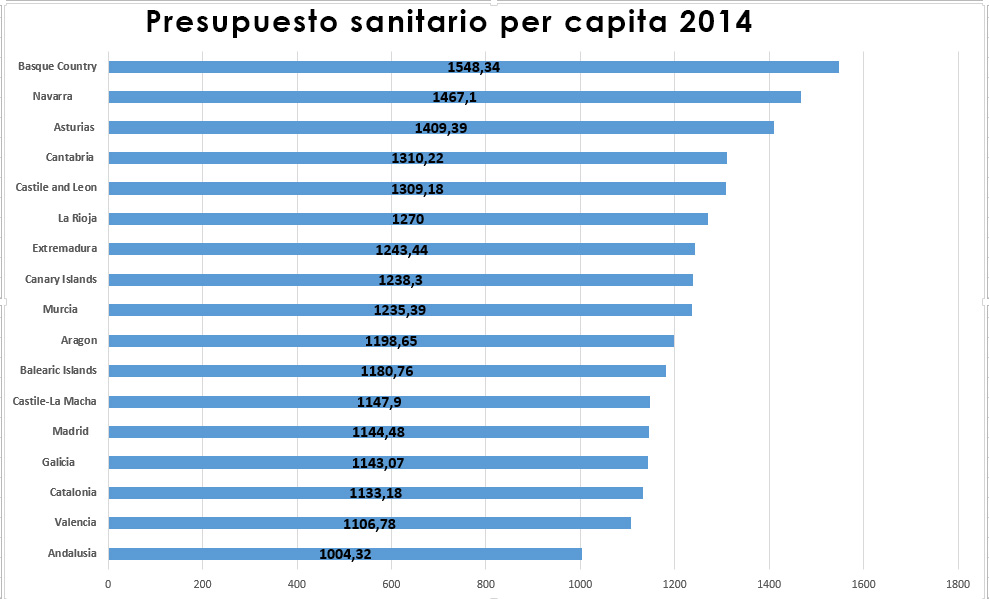
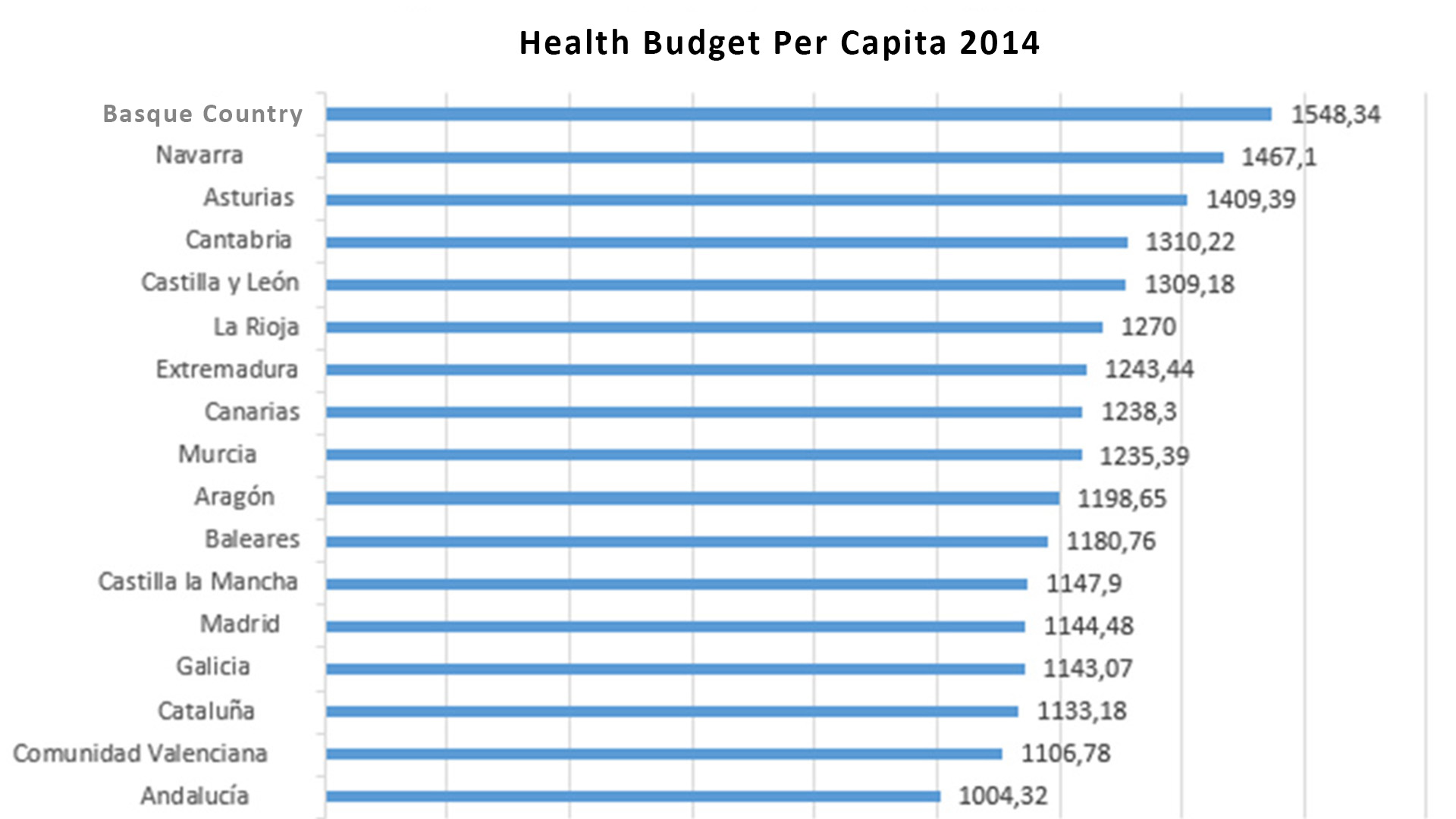
The Basque Autonomous Community has become the autonomous community with the best health services after surpassing Navarre, which used to occupy this position, and has the highest budget per capita in the country, 1,548 Euros in 2014.
These data appear in the Report on the Health Services of the Autonomous Communities prepared by the Federation of Associations in Defence of Public Healthcare, according to which the Basque Country is followed by Navarre and Aragon in the ranking, although the report underlines that in the last year the “general deterioration” of the services has continued due to the “cuts” in public health funding.
The study concludes that the best services are offered by the Basque Country, which ranks higher than Navarre, and these autonomies are followed by Aragon and Asturias.


Health services are fair in Castile and Leon, Cantabria, Galicia, La Rioja and Andalusia and poor in Madrid, Murcia, Baleares, Castile-La Mancha and Extremadura.
The worst are those in the Canary Islands and Valencia, just like in the last six years, followed by Catalonia, a community which has moved back four positions and ranks fifteenth, down from the fifth position it occupied in 2009.
Likewise, the weight of private healthcare is greater in some regions than in others and Madrid, Catalonia, Valencian Community and Balearic Islands head the ranking in this regard.
The study comprises parameters per community such as waiting lists, expenditure per capita, number of beds and professionals, number of operating theatres, cesarean sections and CAT-type tests, pharmaceutical expenditure or the opinion of the citizens.
As for the health budget per capita in 2014, the highest is in the Basque Country (1,548.34 Euros) as opposed to Andalusia (1,004.32 Euros) whereas the highest number of Primary Care doctors per 1,000 inhabitants is in Navarre (2.34) and the lowest in Andalusia (1.54).
The opinion of the citizens is also reported and there are considerable differences between communities with regard to the percentage of people who are satisfied with the Health System, ranging from 7.18 % in Navarre to 5.55 % in the Canary Islands.


Osakidetza (Servicio Vasco de Salud/Basque Health System) is the public healthcare system of the Basque Country, a region located in the north of Spain. Osakidetza was created by the Health Department of the Basque Government in 1983. All the public hospitals and primary care of the Basque Region are under this organization.
The Basque Health System includes 14 hospitals, more than 100 primary care clinics organised through four different geographical areas, apart from the Mental Health Centres, Emergencies and Basque Transfusions and Human Tissue Centre. More than 30.000 professionals work for Osakidetza, which could be considered the biggest organization of the Basque Country.
Osakidetza has a target population of more than 2 million inhabitants. It is estimated that in 20 years, 26% of the Basque population will be older than 65 years old, so this epidemiological pattern requires the improvement of the management of chronic diseases. In the last 15 years, the prevalence of chronic patients has increased remarkably all over the region, so actions related to the patient empowerment through e-Health tools are considered a big challenge for the region.
Mental Health Services in the Basque Country are based on the community care model which (i) promotes integration and standardisation of mental health care services, (ii) gives support and facilitates social integration and normalisation of the affected population and (iii) endorses coordination of social and health cares.

Mental health Services consist of three regional networks with 4 psychiatric hospitals (777 beds), two contracted long-term mental hospitals and several mental health centres in close collaboration with Primary Care. Mental Health Services in the Basque Country consist of departments and functions across the three provinces of the Autonomous Basque Community. The portfolio of services offered by the Mental Health Department covers general psychiatry (mild and severe health disorders), child-adolescent psychiatry and specific services such as alcoholism, compulsive gambling and drug addiction. The existing services are oriented to face a wide range of disorders such depression, schizophrenia, panic disorder, psychosis, eating and sleeping disorders and suicidal tendencies.

QUESTIONNAIRE


If you answered "yes" to between one and four questions then you have a lot of room for improvement in your lifestyle. Look at the pattern of your answers to find out where you are not concentrating on good health. If you feel unable to make changes yourself, ask an adult or professional to help you.
Visit your local library for more information, or scour the Internet for sites that you trust and implement some of their tips. But make changes soon, before your unhealthy lifestyle has any lasting consequences.
If you answered "yes" to between five and eight questions then you have a fairly healthy lifestyle. However, you can never take your good health too seriously. Try to target a few areas in which you can improve and think up a few easy changes that you can make in your daily life. It may be as easy as going to bed an hour earlier or switching from candy to fruit as your afternoon snack. Whatever it is, dedicate yourself to making changes and celebrate when you do!
If you answered "yes" to nine or more of these questions then you have a healthy lifestyle. For optimal health, work on any topic to which you answered "no". Lucky for you there does not seem to be many areas on which to concentrate. But while you obviously take care of yourself well, for the brightest future you must look after all areas of your physical and emotional health. If you find that you are unable to identify areas of change yourself, consider asking a trusted adult or a health professional for guidance.


http://www.teenissues.co.uk/questionnaire-do-i-have-healthy-lifestyle.html


https://docs.google.com/forms/d/e/1FAIpQLScoPE2vtdWCfKxeUAOKEnTko8zJrcoEf8K4yVrchgGb2SRu-w/viewform